Showing posts with label gabe charboneau mma. Show all posts
Showing posts with label gabe charboneau mma. Show all posts
Wednesday, November 27, 2013
MMA "Grows up" Pueblo MMA Coach joins ranks
Several years ago MMA was considered more entertainment than sport, much like Pro Wrestling. Fighters lacked any real identity with the general public hence UFC's big push to develop 24/7 style shows in the spirit of HBO's popular namesakes. To see MMA even considered alongside traditional collegiate, scholastic sports was almost unheard of, until 2013. Pacific Warrior MMA in Pueblo is proud to announce head coach Gabe Charboneau was voted a silver award at the annual Best in Pueblo awards for committment to the sport and community. Charboneau digressed, stating that the award was a byproduct of the positive efforts of the coaches, students and family around him at Pacific Warrior than his own efforts. The award was not relegated to simply combat sports but coaches throughout the area in track, baseball, wrestling etc. Charboneau states "The real credit should be given to our amazing staff of coaches Steve Stickler (BJJ) Haven Torres (grappling /kids) Bruce Ries (Wrestling) Zach Valdez (Wrestling) Jeff Santos (Striking) and our wonderful advisors Donnie Liles and Tori Adams who aid in the development of our programs. We are proud to make good fighters but we would rather develop better people along the way." To see the official awards site follow the link below: http://www.bestofpueblo.com/2013/places-faces/coach-2/

Setting up the Takedown With Striking Coach Gabe Charboneau
Video Courtesy of Fight Life Media, Fight Life Las Vegas Professional MMA and Striking Coach Gabe "Kuya" Charboneau shows how to integrate strikes with clinch and takedowns. Kuya has worked with elite level athletes in Boxing, MMA, Muay Thai and more for over 20 years, is a frequent coach at CBD Tuff Camp alongside Matt Lindland, All American and Team Noguiera coach Eric Alberricin, Keith Wilson and more.
Thursday, April 4, 2013
Respect & credit your wisdom By Gabe Charboneau

Respect & credit your wisdom
By Gabe "Kuya" Charboneau
The sport of mixed martial arts often times today presents a double edged sword:
The great thing about MMA today is it allows easy access to training.
The bad thing about MMA today is it allows easy access to training.
When does access become too easy and the wisdom imparted by a good coach or instructor undervalued? The great coaches of our era are fast becoming extinct. Men with names like Eddie Futch, Cus D'mato, and many others who's lives read like an encyclopedia of knowledge on the subject of combat.
In today's society if one wants to learn from Greg Jackson, Freddie Roach or any of the famed Gracie names one has only to log on to you-tube to obtain a private one on one. For the right price one can simply "send away" for an internet learning program complete with the instructor who will fly in periodically to belt your students in an odd format that allows white belts to teach so they can continue to generate enrollment for the academy. This creates a situation where the head of the program is forced to rank the instructor of the academy in a matter of months vs the traditional method so the new white belts can advance their stripes. Still others, claiming no allegiance to any one gym or school utilize the drop in policy and relaxed atmosphere most mma gyms maintain under the guise of "cross training." They are often welcome to the same quality of instruction enjoyed by the paying full time students at a fraction of the cost and once fulfilled are able to move about freely to the next academy. Right or wrong, this is part and partial of the sports continuing development and man's unquenchable thirst for want it all and want it now.
What is the value of a good teacher?
To this end I maintain that the best coaches are bound to their students by chemistry. One has only to see the relationship between Freddie Roach and Mannie Pacquiao to realize that the magic made by those two may never have happened between another combination. In era's past the student had to gain the trust and acceptance of the teacher, tasks were assigned and standards set to gain entry to the inner sanctum. Respect, loyalty, sweat and hard work were not only expected but demanded. I am a firm believer in preserving the teachings and contributions of the old guard so that this knowledge may be shared for generations to come. This lies at the heart of the paradox described in the first paragraph of this article. It cannot and should not be taken for granted. It has become too easy to gleam once guarded material and continue to do so with little regard for the source from whence it came. I had to travel around the world over the years for my martial education. I saved my money and went to the sources to get it. I never expected free, was respectful and worked hard. Along this journey my pads have touched the gloves of elite level pros and beginners alike yet I have never failed to credit knowledge shared with me. Even today if working with another coach or instructor at their gym I ask permission if there's something I particularly like and I ask them if I may reshare it.
Teaching is often soul work and most fighters today pay little for wisdom gained over a lifetime of a good coach. Honor them by helping their teachings live on
Friday, March 29, 2013
Gabe Charboneau's Pacific Warrior MMA CMTA's newest affiliate gym.

More info on the CMTA can be found below:

We established the Colorado Muay Thai Association in 2011 with the goal to promote and protect the art of Muay Thai. Our focus is to increase the overall awareness and participation in the sport. Our mission is to spread the popularity of the sport within the State of Colorado and to provide fighters with a platform to showcase and grow their skills through certified instruction, world class seminars, amateur tournaments and promotions.
Our judges and referees have been trained under the direction of the Sport Authority of Thailand and WBC Muay Thai licensed referee and judge Dej "Nokweed" Sri-Ampai.
Check out our membership page on more ways that you can become involved in this community
Wednesday, December 26, 2012
Gabe Charboneau MMA Coach, Presenter, Speaker
Gabriel Charboneau
Martial Arts Resume
· Wrote the first Anthropology work on cultural and ethno-geographic similarities of the Polynesian Warrior class (“Toa” Contrasts in the Island Warriors 2001)
· One of very few accepted from the mainland to learn and study traditions of the forbidden Hawaiian Warrior art of Lua at Kamehameha in the Hawaiian School system (Nu’uanu Hawaii)
· Member of Lua Halau O’ Kaihewalu Hawaiian Martial Arts Society
· Highest ranking Filipino Martial arts instructor in Southern Colorado specializing in striking, boxing grappling and weaponry arts as well as mixed martial arts (32 years)
· Recognized by worldwide Kaptiran Mandirigma Association of Filipino martial arts instructors under Shelly Millspaugh, Kyno Valle, Tim Mills and Jhun Pecao
· Recognized Instructor World Kali Silat Organization (Negros Occidental Philippines)
· Certified instructor in JKD concepts under Richard Aragon (boxing, trapping, striking grappling)
· Brown belt in Japanese Aikido Sensei Henry Duran
· Green belt in Shotokan karate Sensei Leroy and Louanne Razo
· Endorsed by Vee Arnis jitsu trainers of Special forces and law enforcement (Sensei’s Eric Lalone, Mike Swayde and John Petrone)
· Endorsed by World Martial Arts Hall of Fame inductee and Judo Blackbelt Donnie Martinez
· Endorsed by Jacksons MMA Manager Rick Kottenstette and former Jacksons matchmaker Dickie Chavez
· Endorsed by noted boxing and mma management firm Mezereon Managements, Lisa Hudson Webb
· Endorsed by Colorado State Athletic commission members for professionalism (Eric Heinz, Ginny Mackelroy and Master Level Instructor Tim Mills.)
· Endorsed by UFC level boxing trainer former GTC Striking Coach and head of Finisher Boxing Paulino Ibarra.
· Endorsed by Tale of the Tape Radio owner, Tapout Magazine and Ultimate MMA Worldwide writer and BJJ specialist Adam Villareall
· Endorsed by former owner of the world’s largest MMA Management firm and MMA legend Ken Pavia.
Have trained in the following other various martial arts over the span of the last 30 years:
· Southwest representative for constellation Afro Carribbean combatives via the foremost experts on the subject in the United States, Kawaun Adon and Daniel Marks of Brooklyn New York and Zab Judah’s gym in 52 blocks, Western boxing and traditional martial arts of the Diaspora
· Traditional Polynesian and Maori Martial arts under Make Clawson of Laie, Hawaii, Dr. Pita Sharples, Matai, Siaosi Talitimu and Iriangi a Tiakiawa
· Saylor Japanese style Judo and Juijitsu James Branson Marquina and Eddie Armijo
(Japanese Judo and traditional swordsmanship) Judo under Blackbelt and Hall of Famer Donnie Martinez
· Indonesian Thai and SE Asian styles under Guro Bob Orlando, Guro James Branson Marquina, noted authors Chas Clements and Steve Gartin and occasionally Dan Inosanto or his styles representatives Mike Brewer and others.
· Filipino Kickboxing “laban sa tama” Guro James Branson Marquina
· Traditional Meso-american martial arts Kyno Balles and Manuel Lozano
· Wrestling under National Champion Mark Villalobos, Larry Wagner and Elite World class Coach Keith Wilson along with submission grappling under Tori Adams and Donnie Liles
· Boxing at Olguin’s Salt Creek Boxing Gym, Armando Montoya, Gareth Pacheco, Leroy Baca, AJ Yamar Resto, and others
Accomplishments
· Former MMA, Toughman, boxing, grappling and no rules Stick-fighting competitor
· One of the first mma competitors in Colorado circa 1994-98 alongside Nate Mardquart, Duane Ludwig, Ron Waterman and other pioneers such as Donnie Martinesz, Oscar Martinez, and Joe Montalvo etc. (Lone wolf tournament and Bas Rutten invitational an early UFC talent pool tourney)
· Lifetime Achievement Award Winner for contributions to the martial arts Pueblo Warrior Conference held at Sangre De Cristo Arts Center in 2002.
· Traveled with 11x World Full contact and WKL hamp Angie Hayes as head coach to Amaan Jordan where she became the first female fighter to ever compete in public there
· Designed the first implemented program in the country (Team Pueblo) to use the sport of mixed martial arts as a platform for philanthropy which would also become the pedestal behind Colorado’s biggest show tens of thousands of dollars raised for charity and countless man hours in the service of our local communities.
· Secretary of the Board for Bully Management inc. which works to use athletes as a conduit to speak out against bullying and its negative social effects in schools.
· Pueblo Sheriff’s Department CQC tactics instructor for commander Mccain
· Fort Carson Military Police Police CQC Instructor (Special Response Team)
· Led the top #2 and #3 mma team in Colorado 2009/2010 (source: MMA buzz.com) advocate for change in format to present Team points concept.
· Coached more champions than any other gym in Pueblo Colorado and its surrounding area spanning over 27 title champions not counting out of area athletes.
· Led international MMA Business Development and Marketing team for 3 years alongside top personalities Matt Lindland, Ken Pavia and former UFC competitor Bill “The Butcher” Mahood. (Takedown Fight Media)
· Developed small local promotion into Colorado’s biggest concurrent running mma show averaging 3000-5000 an event steelcityrumble.com and fightbrigademma.com
· Matchmaker and or key resource for over 26 MMA shows across the Southwest.
· Founder of Colorado’s one and only professional coach and corner-man camp with Doc Alex Constantinides (Ringside physicians association, Sports weight cutting expert Neil Kirby, Corner-man Haven Torres and others.
· Founder and promoter of the first MMA Awards show in the Southwest Colorado 2009-2010 which targeted Southern Colorado Fighters and their achievements but included statewide promotions and nominees
· Multi-time invitee to the world’s most elite grappling/combat sports camp CBD Tuff Camp with Team Nogueira head wrestling Coach Eric Albericcin, Matt the Law Lindland, Keith Wilson, Enrique Montiel, former San Francisco 49r’s player and Olympian Steve Neil and Olympic coach Tadaaki Hatta
· Multi Time guest instructor “Rocky Mountain Combat Conference” alongside elite tactical instructors.
· Have been invited as a guest seminar instructor at over 50 gyms, conferences, camps and other training opportunities over the years.
Has worked with, ran training or mitt-work sessions for, aided in camp strategy or other MMA duties for:
· UFC featherweight Jon Dodson
· Strikeforce IFL competitor Donnie Liles
· Sharkfights competitor and knockout artist Jeremy the Grizzly Kimball
· Top Elite female Tori Adams
· 11x World full contact champion Angela Hayes
· Former TUF competitor Ran Weathers
· Sharkfights/Strikeforce veteran Lionel Lanham
· Legacy Fights Donnie the Bomber Bell
· Team Nogueira coach Eric Alberricin
· UFC competitor Eddie Yagin
· XFS champ and Marine MMA Team champ Jered Lowe
· KOTC veteran Ryan Axtell
References, Letters and Testimonials:
Paulino Ibarra former Grudge Training Center Boxing Coach Denver-
"Gabe is more then a coach and trainer he's more of a professor historian on the sport. He's educated on what he teaches and is always a student of the game. He lacks no heart and puts it in his teaching. He's one of those real trainers you want to be around to learn all you can from him.Don't let the opportunity pass to work with Professor Gabe Charboneau". Recommended by me Paulino Ibarra @Finisher Boxing!
Mike Swayde MMA Instructor Certified strength and conditioning coach and MMA competitor-
"I met Gabe Charboneau while fighting in his second Steel City Rumble promotion. Since that time I have moved on to becoming an MMA instructor myself with students of all ages. Kuya Gabe has been not only an outstanding promoter and MMA coach, but also a mentor to all who come in contact with him. His knowledge of combative sports exceeds most. His willingness to assist other coaches and teams is always present. I have the utmost respect for not only his coaching skill, Martial Arts knowledge, and innovative techniques, but also his moral compass and dedication to his students, family and his efforts to improve the communities that surround him. I cannot say enough good things about Gabe, nor could I recommend him any more highly". - Sensei Mike Swayde, Bushido Sei Shin Jitsu Instructor
Neil Kirby- Strength and conditioning coach, weight loss specialist for sport athletes author of An Athletes guide to scientific weight cutting- "Gabe’s training is Top Notch, not to be missed!"
JR. Gordon Owner and head Content Writer at MMA Buzz- (attached)
Ken Pavia Owner at MMA Agents (attached)
Adam Villareal (attached)
Zara Shirwin, Publicist UK MMA (attached)
Gabe Charboneau MMA Coach, Presenter, Speaker:
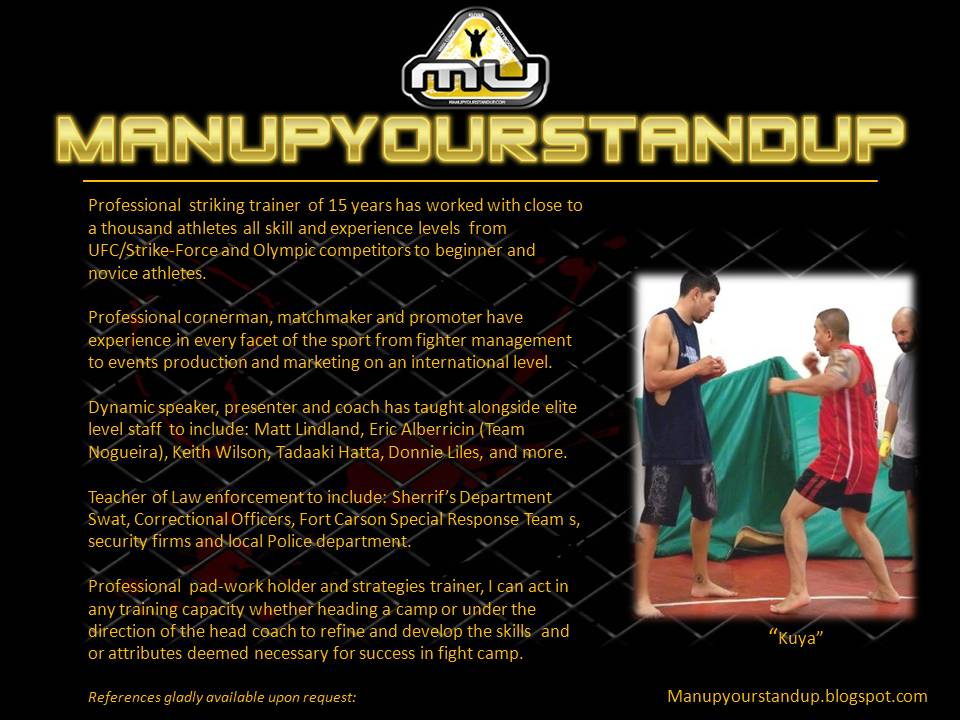
Following are a few visual slides that will help you gain get a better insight to the the mind behind Manupyourstandup. Gabriel Charboneau is available along with Strikeforce and IFL athlete Donnie Liles and or womens elite Olympic competitor Tori Adams for lecture, individual or group training, seminars and or fight camps. Professional to beginner level padwork and implementation strategies.
Lecture topics can include: Personal power, Keynote address, Gang intervention and or anti-Bullying topics (age specific) or the business of mixed martial arts. Please send all email inquiries to: gabe@nuworldmedia.com

Wednesday, August 29, 2012
The Foot-load Series
How to Combine Elite Striking with Wrestling for MMA Mechanics and alignment part 1.
 Mechanics and alignment, the foundation of the foot load.
One of the major problems that I see boxers and mixed martial arts fighters alike suffer from today is a foundation of sound body mechanics. While minimal motion without foot rotation may seem to conserve energy and increase speed in the short term it is largely problematic when trying to teach the same individuals a good power base and also how to hit with power while staying on the balls of the feet as movements are predominately shoulder and arm only. Take the same individuals now attempting to cross train in Muay Thai for instance, and it is readily apparent that this lack of pivoting fundamentals is insufficient to turn the hip over and rotate the ball of the supporting leg. This has bred a nation of flashy arm punching point fighters who rely on the shoulders to bear the load that a simple foot turn could alleviate.
They throw short almost choppy punches because the tend to stay flat and lack spring, and as it applies to this writing will always have a hard time erasing the lines that separate both ranges and styles. The foot-load series as we will call it is based around the principle that there is a common movement that binds each range together and for our purpose here it is the pivot motion of coil and recoil that can be used to do so. Is it not a rear foot pivot that makes a right cross and right round kick work? A torqued left hook and penetration step with the left foot pivoted work harmoniously to set the other up.
Mechanics and alignment, the foundation of the foot load.
One of the major problems that I see boxers and mixed martial arts fighters alike suffer from today is a foundation of sound body mechanics. While minimal motion without foot rotation may seem to conserve energy and increase speed in the short term it is largely problematic when trying to teach the same individuals a good power base and also how to hit with power while staying on the balls of the feet as movements are predominately shoulder and arm only. Take the same individuals now attempting to cross train in Muay Thai for instance, and it is readily apparent that this lack of pivoting fundamentals is insufficient to turn the hip over and rotate the ball of the supporting leg. This has bred a nation of flashy arm punching point fighters who rely on the shoulders to bear the load that a simple foot turn could alleviate.
They throw short almost choppy punches because the tend to stay flat and lack spring, and as it applies to this writing will always have a hard time erasing the lines that separate both ranges and styles. The foot-load series as we will call it is based around the principle that there is a common movement that binds each range together and for our purpose here it is the pivot motion of coil and recoil that can be used to do so. Is it not a rear foot pivot that makes a right cross and right round kick work? A torqued left hook and penetration step with the left foot pivoted work harmoniously to set the other up.
 This is the foundation of what we are trying to achieve with this method. Patience, repetition in developing these attributes and sound fundamentals from the beginning will result in a better understanding of how the body works, where its pivot points and angles are, and overall make you well rounded polished fighter.
In forthcoming issues, techniques, training and development will be discussed.
This is the foundation of what we are trying to achieve with this method. Patience, repetition in developing these attributes and sound fundamentals from the beginning will result in a better understanding of how the body works, where its pivot points and angles are, and overall make you well rounded polished fighter.
In forthcoming issues, techniques, training and development will be discussed.


Tuesday, November 8, 2011
Quality Control Coaching MMA’s Missing Ingredient
Quality Control Coaching MMA’s Missing Ingredient
I recently had the good fortune of meeting up with an old friend from years ago Kru Oscar Martinez at an event in which I was coaching and he was officiating for the Colorado State Athletic Commission. During the course of our conversation, we spoke about what we were currently up to and reminisced about our early days in the sport. This brought back a flood of fond memories, spawned some questions about the direction MMA has taken and where we each saw it going in the future. And while the focus of this article as the title alludes to is quality control coaching, I would for a moment ask that you grant me an opportunity to share with you a special piece of history that is gone forever, one that had a monumental impact on our sports development and yet the masses will never know it existed.
Early Development
When I first began competing somewhere around circa 1995-96 there was no such thing as Mixed Martial Arts. At the time the activity that would later become known as such was simply referred to as either “Pit-Fighting or NHB (No Holds Barred). During this embryonic period there was a little promotion ran out of Bing Tran’s CMGA in Littleton, Colorado called The Lone Wolf Tournament. This event was true gladiatorial combat at it’s finest. Weight classes spanned 40lb differentials, up to 20 minute time limits were the norm, you could fight numerous times in a night and the bouts were set up to showcase different skillsets. This means that there might be a Muay Thai match followed by a grappling match followed by an NHB bout and oh what glorious time it was. While these fights remain for the most part obscure and unrecorded by history or sanctioning body I was blessed to witness near teenagers at the time with names like Ludwig, Kronk, Mardquart and Waterman enter the arena of battle years before they would become legends of the UFC. I remember Oscar Martinez winning end of the night honors for Muay Thai and many like Donnie Martinez, Joe Montalvo and big John Patrone from the Defense Institute all who would go on to be great teachers themselves make their fighting debuts alongside me.
End of An Era
However with the arrival of the new millennium, came regulation of the sport by the boxing commission. This signaled the death rattle of unsanctioned events in Colorado and the sport, by now called MMA continued to experience exponential growth much like the ninja craze had done a decade beforehand. As with any opportunistic endeavor everyone rushed out to monetize on the newfound cash cow and what ensued, both good and bad created the springboard for what we now know as our sport today.
Coaching Chaos
It is my observation that MMA grew large so fast in such a short amount of time that it never quite had a chance to fully develop uniform teaching structures, well rounded coaches and business models on average to support the amount of “gyms” and “fight teams” that were popping up on every street corner. This is certainly not meant to accuse, point fingers, or paint anyone with a negative brush as there are of course many reputable gyms/teams in my home state of Colorado and around the world. Rather, I hope this article will serve as a conduit for introspection, one that can help us all get better at what we do. Now, if we look at the sport as a whole we will see that there are really 3 major types of teaching models. Please take into account that all approaches have good and bad points I am merely generalizing each one for a big picture perspective.
1. The training “group” this is the team in which noone on average has a clearly defined role except usually the “team manager” who supplies the t-shirts and promotional items and usually takes the role of matchmaking for the group as well. In this model we see individuals who come together to work toward a common goal and for the exchange of knowledge and techniques i.e. one has done boxing the other some jujitsu, a few are wrestlers etc. This comprises the most common category today at an amateur level though this does not exclude them from having pros in their stable. They are often tight knit and bound by friendship at their core. The advantages of this type of group are trust and loyalty, the downside is often training space, resources and equipment.
2. The traditional school who, seeing their profit centers shrink in lieu of mixed martial arts decides to add an mma class/team. This school has primarily relied on traditional arts involving cardio, kids and self defense. However, because the popularity of MMA is unmistakable they will either bring in an affiliate grappling program and or hire an instructor and by mixing their kickboxing with grappling they are able to stave off profit loss by diversifying with MMA. The advantages of this group are usually very clean facilities and usually well equipped but on the norm do not have access to very MMA specific resources as it pulls capital away from their primary focus women, children and cardio.
3. The barber shop is based off the same model as well ,a barber shop. An owner buys a building and sublets or leases different time slots and classes to provide a variety of curriculum to choose from. Usually this includes a boxing coach, a Muay Thai Kru, A wrestling coach, and BJJ coach. This model is usually the most successful of the 3 approaches and keeps pro fighters at the forefront of priority. Advantages of this program are very much resource based, cage equipment high quality instruction the downsides are lack of personalized focus on beginner levels, and if there’s not enough communication you have several different disciplines telling you several different ways to do things in which none may be specific for mma.
The Future
As far as this sport has come and continues to mold and evolve today, it can always get better. We as coaches need more quality control in our programs. There are many coaches who have no idea how to break down their techniques and skillsets in a manner that allows one to set up the next. I see too many “friends” in corners when what an athlete really needs is a coach. I see coaches who’s idea of advice for their fighter while he’s getting pounded is simply: “be stronger” or “take him down”! I have seen 3 different coaches yelling 3 different commands in unison while their poor discombobulated guy is having a hard enough time listening to one. I have seen world class reputable gyms fumbling around locker rooms asking to borrow scissors or for someone to wrap their fighter’s hands. The defining point here is that we as a community of professionals (and amateurs) need to step up to the plate and better learn our jobs. We need to stop being so vain and ask for help in learning things we don’t know. That means, learn how to teach, learn how to do a lesson plan so we are not doing something different every day that we won’t see again for two months until we have forgotten it. It means structuring progressive, comprehensive programs that take a student from point a to point b, it means learning that sparring and rolling at a 100 percent every day doesn’t make you look tough it guarantees you a short career. Coaches need to learn how to strategize, do homework, how to game plan, how to cut weight and prepare properly and most importantly safely. We have an opportunity here to create the next generation of mixed martial arts greats and they will be a direct byproduct of the training environments they are bred in. So, no matter which of the 3 gym types you fall under, let’s help this next generation of greats put their best foot forward.-
-Kuya
I recently had the good fortune of meeting up with an old friend from years ago Kru Oscar Martinez at an event in which I was coaching and he was officiating for the Colorado State Athletic Commission. During the course of our conversation, we spoke about what we were currently up to and reminisced about our early days in the sport. This brought back a flood of fond memories, spawned some questions about the direction MMA has taken and where we each saw it going in the future. And while the focus of this article as the title alludes to is quality control coaching, I would for a moment ask that you grant me an opportunity to share with you a special piece of history that is gone forever, one that had a monumental impact on our sports development and yet the masses will never know it existed.
Early Development
When I first began competing somewhere around circa 1995-96 there was no such thing as Mixed Martial Arts. At the time the activity that would later become known as such was simply referred to as either “Pit-Fighting or NHB (No Holds Barred). During this embryonic period there was a little promotion ran out of Bing Tran’s CMGA in Littleton, Colorado called The Lone Wolf Tournament. This event was true gladiatorial combat at it’s finest. Weight classes spanned 40lb differentials, up to 20 minute time limits were the norm, you could fight numerous times in a night and the bouts were set up to showcase different skillsets. This means that there might be a Muay Thai match followed by a grappling match followed by an NHB bout and oh what glorious time it was. While these fights remain for the most part obscure and unrecorded by history or sanctioning body I was blessed to witness near teenagers at the time with names like Ludwig, Kronk, Mardquart and Waterman enter the arena of battle years before they would become legends of the UFC. I remember Oscar Martinez winning end of the night honors for Muay Thai and many like Donnie Martinez, Joe Montalvo and big John Patrone from the Defense Institute all who would go on to be great teachers themselves make their fighting debuts alongside me.
End of An Era
However with the arrival of the new millennium, came regulation of the sport by the boxing commission. This signaled the death rattle of unsanctioned events in Colorado and the sport, by now called MMA continued to experience exponential growth much like the ninja craze had done a decade beforehand. As with any opportunistic endeavor everyone rushed out to monetize on the newfound cash cow and what ensued, both good and bad created the springboard for what we now know as our sport today.
Coaching Chaos
It is my observation that MMA grew large so fast in such a short amount of time that it never quite had a chance to fully develop uniform teaching structures, well rounded coaches and business models on average to support the amount of “gyms” and “fight teams” that were popping up on every street corner. This is certainly not meant to accuse, point fingers, or paint anyone with a negative brush as there are of course many reputable gyms/teams in my home state of Colorado and around the world. Rather, I hope this article will serve as a conduit for introspection, one that can help us all get better at what we do. Now, if we look at the sport as a whole we will see that there are really 3 major types of teaching models. Please take into account that all approaches have good and bad points I am merely generalizing each one for a big picture perspective.
1. The training “group” this is the team in which noone on average has a clearly defined role except usually the “team manager” who supplies the t-shirts and promotional items and usually takes the role of matchmaking for the group as well. In this model we see individuals who come together to work toward a common goal and for the exchange of knowledge and techniques i.e. one has done boxing the other some jujitsu, a few are wrestlers etc. This comprises the most common category today at an amateur level though this does not exclude them from having pros in their stable. They are often tight knit and bound by friendship at their core. The advantages of this type of group are trust and loyalty, the downside is often training space, resources and equipment.
2. The traditional school who, seeing their profit centers shrink in lieu of mixed martial arts decides to add an mma class/team. This school has primarily relied on traditional arts involving cardio, kids and self defense. However, because the popularity of MMA is unmistakable they will either bring in an affiliate grappling program and or hire an instructor and by mixing their kickboxing with grappling they are able to stave off profit loss by diversifying with MMA. The advantages of this group are usually very clean facilities and usually well equipped but on the norm do not have access to very MMA specific resources as it pulls capital away from their primary focus women, children and cardio.
3. The barber shop is based off the same model as well ,a barber shop. An owner buys a building and sublets or leases different time slots and classes to provide a variety of curriculum to choose from. Usually this includes a boxing coach, a Muay Thai Kru, A wrestling coach, and BJJ coach. This model is usually the most successful of the 3 approaches and keeps pro fighters at the forefront of priority. Advantages of this program are very much resource based, cage equipment high quality instruction the downsides are lack of personalized focus on beginner levels, and if there’s not enough communication you have several different disciplines telling you several different ways to do things in which none may be specific for mma.
The Future
As far as this sport has come and continues to mold and evolve today, it can always get better. We as coaches need more quality control in our programs. There are many coaches who have no idea how to break down their techniques and skillsets in a manner that allows one to set up the next. I see too many “friends” in corners when what an athlete really needs is a coach. I see coaches who’s idea of advice for their fighter while he’s getting pounded is simply: “be stronger” or “take him down”! I have seen 3 different coaches yelling 3 different commands in unison while their poor discombobulated guy is having a hard enough time listening to one. I have seen world class reputable gyms fumbling around locker rooms asking to borrow scissors or for someone to wrap their fighter’s hands. The defining point here is that we as a community of professionals (and amateurs) need to step up to the plate and better learn our jobs. We need to stop being so vain and ask for help in learning things we don’t know. That means, learn how to teach, learn how to do a lesson plan so we are not doing something different every day that we won’t see again for two months until we have forgotten it. It means structuring progressive, comprehensive programs that take a student from point a to point b, it means learning that sparring and rolling at a 100 percent every day doesn’t make you look tough it guarantees you a short career. Coaches need to learn how to strategize, do homework, how to game plan, how to cut weight and prepare properly and most importantly safely. We have an opportunity here to create the next generation of mixed martial arts greats and they will be a direct byproduct of the training environments they are bred in. So, no matter which of the 3 gym types you fall under, let’s help this next generation of greats put their best foot forward.-
-Kuya
Monday, November 7, 2011
"Defenders of the Flame" lighting the pathway for 52 Handblocks boxing
Preface
Over the last several years many “authorities” have come forth to try and discredit what we know as 52 blocks, Stato, Jailhouse Rock, or any of the other generational or geographic terms associated with this style of pugilism. While It’s modern roots can be found everywhere from breakdancing to professional boxing there are those who refuse to even believe it exists much less consider it a codified method of self defense. I can only speak on that which I know and while I am also a professional MMA and striking coach my core is Filipino Martial arts in fact =29 years and 3 generations worth of practitioners. To this end I would ask, what are the parameters set forth by the naysayers as to whether a martial art is considered legitimate?
Tribal structure the “Common Thread”
Before you set fire to my flag here, please take a moment to realize the commonalities in the two. To the case in point for people like Phil Elmore, FMA would not qualify as a codified martial art due either to lack of written records, scrolls and other circumstances which would seem foreign to those outside this culture and especially those in western mindset who need rational explanation of everything in their world. So too then would all of the martial heritage of Polynesia and Melanesia where oral traditions were the standard due to lack of written record.
This would conclude then that longstanding warrior traditions like Hawaiian Lua, Maori Rongomamau or Rakau, and many others of those regions are less than legitimate as well right? Wrong. Let’s first look at the similarities in societal structure where martial arts remain social, and are not so much rigid as methods of play and self defense handed down over generations under the watchful eye of an elder or big brother who will in turn add his personal “tricks” or flavor that have proven effective for himself over time. This is the same as traditional African methods of martial technology and is largely due to the history of tribal structure versus what we think of as contemporary Asian martial arts. In FMA you have what we call systems, but within systems you also have “styles” which often refer to certain methods of defense or combinations of specific techniques within a system. i.e ocho-ocho or “figure 8 movement” or Crossada or “crossing style” of play.
The Claim of Racism
So why then is it unfathomable to think that at least loose groupings of techniques herein called the 52 blocks could be passed down orally by demonstration, or mimickry through the "play" as stated before? I find it funny that Mr. Elmore referred to the 52 in context as a “racist martial art” due to the supposed opposition to teaching outsiders. Is this not the root of all martial arts? The term martial itself implies warfare and martial arts in this case, would be designed as a method of self preservation against an oppressor whether it be a slave owner or prison guards and therefore whomever was responsible for passing it on would be thoroughly justified in teaching only whomever they deemed worthy.
While I agree that the history is a bit hazy I believe that there are enough unrelated sources who have witnessed this style of play in action, or corroborated life experience either through training or otherwise over the years to deem that there are unmistakeable commonalities in the movements of its purported practitioners to support 52's existence. Even if it is a rebirth or revival of something thought not to exist, then why is the effort to propagate it as such not enough for the masses to qualify it as a martial art? In Cambodia and Thailand you have many trying to revive various older or near forgotten arts and they are considered legitimate. Lua was only rebirthed and reborn through Olohe Charles Kenn’s extensive work with his students Dr. Mitchell Eli and Richard Paglinawan and David Nu’uhiwa so why not 52? FMA continues to be rebuilt and modernized all the time because its dynamic and flexible adaptations to current environments and needs are the keys to it's effectiveness. One could at any point make the same arguments against other modern arts like Kapap, Krav Maga or even Aikido which was only born this century.
To the future
While I as a mere disciple of the craft of 52 and the sweet science of boxing agree that more research is necessary, that is for the black community to do This is their backyard, their treasure to unearth and revive, and their right to preserve what is theirs. All others should be honorable enough to respect that before anyone rushes out to discredit it due to lack of understanding. I am content to believe that many of the techniques contained within its categories are effective and viable and have been proven so for a long time whether it be in a 1920’s or modern era prize ring, the urban streets of 1970’s Bronx or Brooklyn, a beach in Gullah 100 years ago or today by the Constellation family who are now fighting hard to revive and rebirth this gift for the betterment of our youth.
End Note:
Playing the 5's along with my Filipino Martial arts has given me a fun spark, a unique yet familiar and well rounded approach to my boxing practice that I hadn’t felt in a long time. Peace be unto the elders and keepers of the flame good luck in your research.
Haumana/disciple The Ill-a-pino.
Over the last several years many “authorities” have come forth to try and discredit what we know as 52 blocks, Stato, Jailhouse Rock, or any of the other generational or geographic terms associated with this style of pugilism. While It’s modern roots can be found everywhere from breakdancing to professional boxing there are those who refuse to even believe it exists much less consider it a codified method of self defense. I can only speak on that which I know and while I am also a professional MMA and striking coach my core is Filipino Martial arts in fact =29 years and 3 generations worth of practitioners. To this end I would ask, what are the parameters set forth by the naysayers as to whether a martial art is considered legitimate?
Tribal structure the “Common Thread”
Before you set fire to my flag here, please take a moment to realize the commonalities in the two. To the case in point for people like Phil Elmore, FMA would not qualify as a codified martial art due either to lack of written records, scrolls and other circumstances which would seem foreign to those outside this culture and especially those in western mindset who need rational explanation of everything in their world. So too then would all of the martial heritage of Polynesia and Melanesia where oral traditions were the standard due to lack of written record.
This would conclude then that longstanding warrior traditions like Hawaiian Lua, Maori Rongomamau or Rakau, and many others of those regions are less than legitimate as well right? Wrong. Let’s first look at the similarities in societal structure where martial arts remain social, and are not so much rigid as methods of play and self defense handed down over generations under the watchful eye of an elder or big brother who will in turn add his personal “tricks” or flavor that have proven effective for himself over time. This is the same as traditional African methods of martial technology and is largely due to the history of tribal structure versus what we think of as contemporary Asian martial arts. In FMA you have what we call systems, but within systems you also have “styles” which often refer to certain methods of defense or combinations of specific techniques within a system. i.e ocho-ocho or “figure 8 movement” or Crossada or “crossing style” of play.
The Claim of Racism
So why then is it unfathomable to think that at least loose groupings of techniques herein called the 52 blocks could be passed down orally by demonstration, or mimickry through the "play" as stated before? I find it funny that Mr. Elmore referred to the 52 in context as a “racist martial art” due to the supposed opposition to teaching outsiders. Is this not the root of all martial arts? The term martial itself implies warfare and martial arts in this case, would be designed as a method of self preservation against an oppressor whether it be a slave owner or prison guards and therefore whomever was responsible for passing it on would be thoroughly justified in teaching only whomever they deemed worthy.
While I agree that the history is a bit hazy I believe that there are enough unrelated sources who have witnessed this style of play in action, or corroborated life experience either through training or otherwise over the years to deem that there are unmistakeable commonalities in the movements of its purported practitioners to support 52's existence. Even if it is a rebirth or revival of something thought not to exist, then why is the effort to propagate it as such not enough for the masses to qualify it as a martial art? In Cambodia and Thailand you have many trying to revive various older or near forgotten arts and they are considered legitimate. Lua was only rebirthed and reborn through Olohe Charles Kenn’s extensive work with his students Dr. Mitchell Eli and Richard Paglinawan and David Nu’uhiwa so why not 52? FMA continues to be rebuilt and modernized all the time because its dynamic and flexible adaptations to current environments and needs are the keys to it's effectiveness. One could at any point make the same arguments against other modern arts like Kapap, Krav Maga or even Aikido which was only born this century.
To the future
While I as a mere disciple of the craft of 52 and the sweet science of boxing agree that more research is necessary, that is for the black community to do This is their backyard, their treasure to unearth and revive, and their right to preserve what is theirs. All others should be honorable enough to respect that before anyone rushes out to discredit it due to lack of understanding. I am content to believe that many of the techniques contained within its categories are effective and viable and have been proven so for a long time whether it be in a 1920’s or modern era prize ring, the urban streets of 1970’s Bronx or Brooklyn, a beach in Gullah 100 years ago or today by the Constellation family who are now fighting hard to revive and rebirth this gift for the betterment of our youth.
End Note:
Playing the 5's along with my Filipino Martial arts has given me a fun spark, a unique yet familiar and well rounded approach to my boxing practice that I hadn’t felt in a long time. Peace be unto the elders and keepers of the flame good luck in your research.
Haumana/disciple The Ill-a-pino.
Wednesday, July 20, 2011
5 minutes with Vallie Rae Mead
Colorado Fight League Newsletter (Steel City rumble Feature) 5 minutes with Vallie Rae Mead
by Gabe Charboneau on Thursday, April 21, 2011 at 11:23am
STEEL CITY RUMBLE FEATURE
SPOTLIGHT ON
VALLIE MEAD
By CFL Contributor Liz Solano
To a simple passer by, Vallie Rae Mead seems like a beautiful woman, and that's that! Anyone who knows Vallie, knows that she is more than what meets the eye and she will prove it!
BEING A FEMALE IN A MALE DOMINATED SPORT
In a sport where men seem to reign superior, Mead is a women who never let her gender be a handicap. Having been exposed to Martial Arts since the tender age of 13, Mead never let her gender get in the way, “In this sport, it's kill or be killed”, Mead says. She was never babied or treated any different because she's female telling us, “My very first instructor told everyone in our student body, DO NOT treat her any differently”. Starting with Kempo Karate at 13 and then graduating to kickboxing at 18, she knew the discipline and strength it took to train. Training very hard, Mead began to teach students very early, “I felt like I had to establish dominance and show my students who many times were older men, that I knew exactly what I was doing and I would prove it.” Once she stepped onto the MMA scene she says, “I couldn't see myself as a good fighter until I got onto the ground and mastered my ground skills.” While she never felt at a disadvantage due to her gender, she did feel as though she had to prove herself.
BALANCING BEING A MOM WITH TRAINING
Being a parent is trying on anyone. This is even more so the case when you are a single parent, couple that with training and you have a full time job! Vallie has three wonderful children and balancing the three of them with training is the hardest part. Mead is a Martial Artist saying, “This is what I am and what I want, it makes it easier when you know who and what you are... This is what I want!” Mead finds it important to cherish every moment stating, “One day I will be a coach and only a coach, I want to cherish this moment right now!”
HOW SHE PREPARES FOR FIGHT
When I ask a fighter, “How do you get ready for a fight?” The response is often something in the realm of watching the opponents past fights, or making themselves hate their opponent. Not Vallie, she prepares in a way that is very unique.
“I start two weeks out from my fight. I let the adrenaline build and then I ground myself. I use a lot of visualization and disburse the adrenaline and nervousness I feel to my limbs. It's a full body awakening. At that point, my nervousness takes the shape of confidence.”
On top of visualization, the song that the fighter enters the arena with is also very important. “It has to have that certain vibe that releases everything” Unlike many, to Mead, a fight isn't about hating her opponent, but rather, a test of herself. She finds it to be an opportunity to learn more about herself. She doesn't know much about her opponent and she doesn't need to, “I always imagine that my opponent is bigger, faster, and stronger and I have to push myself to be equal.”
WHO SHE WOULD LIKE TO THANK
Like many, she would love to thank her parents, training partners and coach at Team Hitman MMA, and of course her children; but there is a man who passed away that she would like to thank as well, Bill Packer. Bill Packer was her first instructor, a man who was very near and dear to her, and a man who has trained the best with 122 World Champions. Mead remembers her first fight, “It wasn't like the big productions that we have today, it was more underground. I walked into the ring and my feet had dust on them and I was afraid of slipping. I turned to him and said, 'Mr. Packer my feet are dusty' he did what I never expected, he sat me on the stool and proceeded to wash my feet, this man who has trained champions got to his knees and washed my feet. It was a very surreal moment for me.” When Packer passed away, Mead didn't train for a while, “It's hard to find someone to train you after you have learned so much and you have developed such a deep bond with an instructor.” Packer shaped Mead into what she is today and she is grateful.

SPOTLIGHT ON
VALLIE MEAD
By CFL Contributor Liz Solano
To a simple passer by, Vallie Rae Mead seems like a beautiful woman, and that's that! Anyone who knows Vallie, knows that she is more than what meets the eye and she will prove it!
BEING A FEMALE IN A MALE DOMINATED SPORT
In a sport where men seem to reign superior, Mead is a women who never let her gender be a handicap. Having been exposed to Martial Arts since the tender age of 13, Mead never let her gender get in the way, “In this sport, it's kill or be killed”, Mead says. She was never babied or treated any different because she's female telling us, “My very first instructor told everyone in our student body, DO NOT treat her any differently”. Starting with Kempo Karate at 13 and then graduating to kickboxing at 18, she knew the discipline and strength it took to train. Training very hard, Mead began to teach students very early, “I felt like I had to establish dominance and show my students who many times were older men, that I knew exactly what I was doing and I would prove it.” Once she stepped onto the MMA scene she says, “I couldn't see myself as a good fighter until I got onto the ground and mastered my ground skills.” While she never felt at a disadvantage due to her gender, she did feel as though she had to prove herself.
BALANCING BEING A MOM WITH TRAINING
Being a parent is trying on anyone. This is even more so the case when you are a single parent, couple that with training and you have a full time job! Vallie has three wonderful children and balancing the three of them with training is the hardest part. Mead is a Martial Artist saying, “This is what I am and what I want, it makes it easier when you know who and what you are... This is what I want!” Mead finds it important to cherish every moment stating, “One day I will be a coach and only a coach, I want to cherish this moment right now!”
HOW SHE PREPARES FOR FIGHT
When I ask a fighter, “How do you get ready for a fight?” The response is often something in the realm of watching the opponents past fights, or making themselves hate their opponent. Not Vallie, she prepares in a way that is very unique.
“I start two weeks out from my fight. I let the adrenaline build and then I ground myself. I use a lot of visualization and disburse the adrenaline and nervousness I feel to my limbs. It's a full body awakening. At that point, my nervousness takes the shape of confidence.”
On top of visualization, the song that the fighter enters the arena with is also very important. “It has to have that certain vibe that releases everything” Unlike many, to Mead, a fight isn't about hating her opponent, but rather, a test of herself. She finds it to be an opportunity to learn more about herself. She doesn't know much about her opponent and she doesn't need to, “I always imagine that my opponent is bigger, faster, and stronger and I have to push myself to be equal.”
WHO SHE WOULD LIKE TO THANK
Like many, she would love to thank her parents, training partners and coach at Team Hitman MMA, and of course her children; but there is a man who passed away that she would like to thank as well, Bill Packer. Bill Packer was her first instructor, a man who was very near and dear to her, and a man who has trained the best with 122 World Champions. Mead remembers her first fight, “It wasn't like the big productions that we have today, it was more underground. I walked into the ring and my feet had dust on them and I was afraid of slipping. I turned to him and said, 'Mr. Packer my feet are dusty' he did what I never expected, he sat me on the stool and proceeded to wash my feet, this man who has trained champions got to his knees and washed my feet. It was a very surreal moment for me.” When Packer passed away, Mead didn't train for a while, “It's hard to find someone to train you after you have learned so much and you have developed such a deep bond with an instructor.” Packer shaped Mead into what she is today and she is grateful.
Subscribe to:
Posts (Atom)